Your Business Has the Documents. Can Your Employees Actually Use Them?
Most businesses do not have an information shortage.

They have an information-access problem.
Policies are stored in one folder. Procedures are somewhere else. Contracts may be maintained by one employee. Training documents may sit on a shared drive. Product information could be spread across PDFs, spreadsheets, manuals, and archived files.
The information exists.
The challenge is finding the right information at the moment it s needed. Rather than asking employees to manually search through folders, filenames, PDFs, and years of accumulated documents, a private AI document system can help authorized users search approved company information using ordinary questions.
The result is not simply faster document search.
It is a different way of using the knowledge a business already owns.
The Hidden Cost of Document Search
Consider how often employees ask questions such as:
Where is the latest version of this policy?
What does our procedure say about this situation? Which document contains the customer requirement?
What document contains the customer requirements?
What information do I need before beginning this process?
Is this covered in the employee manual?
What does the contract say about this requirement?
Each individual search may take only a few minutes.
But those minutes accumulate.
If several employees spend 10 or 15 minutes each day looking for information, the annual cost can become significant.
The larger problem is that document searching also interrupts work.
An employee stops what he or she is doing, opens several folders, searches filenames, reads through documents, asks another employee, and then attempts to determine whether the information found is still current.
The organization may possess excellent documentation while still struggling to use it efficiently.
File Storage Is Not the Same as Knowledge Access
Cloud drives, shared folders, document-management systems, and company servers are valuable tools.
But storing a document and understanding its contents are two different things.
Traditional search often depends on knowing:
The document name
The correct folder
The right keyword
Who created the file
Approximately when it was created
Employees frequently do not know those details.
They know the question they need answered.
For example, an employee may not know that the answer to a customer-return question is located on page 37 of a document called:
Operations_Manual_Final_Revision_2026.pdf
The employee simply wants to know:
“What is our procedure when a customer requests a return after 30 days?”
A Private Business Document Assistant changes the interaction from:
Find the correct file
to:
Ask the business question.
That distinction can be extremely valuable.
Turning Documents Into a Searchable Business Resource
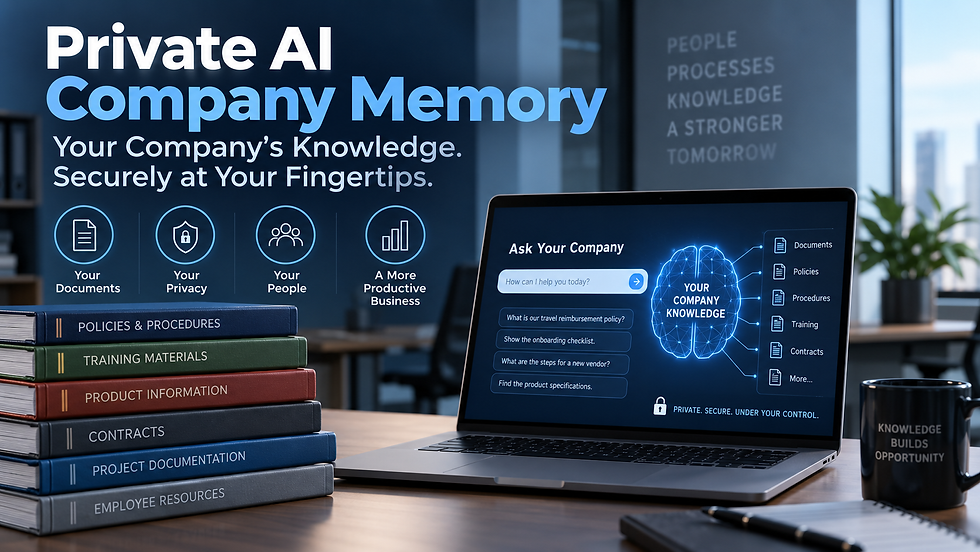
A Private Business Document Assistant can work with approved business materials such as:
Policies and procedures
Employee handbooks
Training manuals
Contracts
Standard operating procedures
Product documentation
Technical manuals
Project documentation
Internal reference guides
Customer-service procedures
Administrative documentation
Compliance materials
The objective is to make those materials easier to use without requiring employees to remember where every piece of information is stored.
Instead of opening document after document, an authorized user can ask a question in ordinary language.
The system can search the approved materials and return information relevant to that question.
For many organizations, that represents a far more natural way of working with documents.
Why Private Matters
Business documents may contain information that an organization does not want broadly distributed.
That can include:
Proprietary processes
Internal procedures
Contract information
Financial material
Customer information
Employee information
Business strategy
Technical documentation
For that reason, businesses should evaluate more than whether an AI tool can answer questions.
They should also ask:
Where are the documents stored?
Which information is being sent outside the organization?
Who controls access?
Which documents are included in the system?
What happens to the information during normal AI use?
A privately deployed document assistant can be designed to give the organization greater control over its information.
Depending on the implementation, business documents and routine AI processing can remain on dedicated private hardware rather than depending on a public cloud AI service for every document query.
That approach can be especially attractive to organizations that place a high value on privacy, control, and predictable operating costs.
The System Should Know What It Does Not Know
One of the most important characteristics of a useful business AI system is not simply its ability to answer questions.
It is its ability to recognize when the answer is not present in the approved documents.
An AI system that confidently creates an answer unsupported by company documentation can create risk.
For example, imagine an employee asks:
“What is our policy on international travel reimbursement?”
If the organization does not actually have an approved international travel policy, the system should not invent one.
A well-designed implementation should help distinguish between:
Information contained in company documents
and
Information that is not available from the approved sources.
That distinction is essential when AI is being used for real business operations.
Formal Testing Before Employees Depend on It
Uploading documents into an AI system is not the end of implementation.
It should be the beginning of testing.
Before a Private Business Document Assistant is introduced for regular business use, it can be tested against representative questions.
For example:
Known-answer test
Ask questions for which the correct answer is clearly documented.
Missing-information test
Ask questions that are not answered anywhere in the approved documents.
Similar-document test
Test situations where several documents contain related information.
Procedure test
Ask questions about multi-step company processes.
Source-validation test
Confirm that answers are based on the appropriate company information.
These tests help determine whether the system is ready for practical use.
They can also reveal problems in the underlying documents themselves.
AI Can Expose Document Problems You Did Not Know You Had
An unexpected benefit of building a document assistant is that it may reveal weaknesses in the company's existing documentation.
For example, the implementation process may uncover:
Duplicate documents
Conflicting procedures
Outdated policies
Missing information
Poorly organized files
Multiple versions of the same document
Procedures employees follow that were never formally documented
This is important.
Sometimes the problem is not that employees cannot find the answer.
Sometimes the organization has never clearly established the answer.
A Private Business Document Assistant can therefore become part of a broader effort to improve the quality of the company's information.
Start With a Controlled Document Collection
There is usually no reason to load every document the company owns on day one.
A more controlled approach may be more effective.
A business could begin with one specific collection, such as:
Phase 1 — Policies and procedures
Then expand to:
Phase 2 — Training and on-boarding materials
Followed by:
Phase 3 — Operations and technical documentation
And eventually:
Phase 4 — Additional approved business knowledge
Starting with a defined document collection makes testing easier and reduces unnecessary complexity.
It also gives the business an opportunity to determine whether employees actually find the system useful before expanding it.
Better On-boarding Without Replacing Human Training
New employees often ask experienced employees dozens of routine questions.
That is normal.
But many of those questions concern information already contained in company documentation.
A Private Business Document Assistant can provide new employees with another resource.
Instead of repeatedly asking:
“Where can I find this?”
They may be able to ask the system directly.
Experienced employees remain available for questions requiring judgment, context, or expertise.
The AI handles information retrieval.
The employee handles the decision.
That is a more realistic role for AI in many organizations than attempting to replace human expertise.
Preserve Knowledge When Employees Leave
Employee turnover can create another document problem.
Long-term employees often know:
Which document matters
Which procedure is current
Where information is stored
How different documents relate to one another
When that employee leaves, the documents may remain—but the knowledge of how to use them may disappear.
Making business documents easier to search can reduce dependence on individual employees who have become the unofficial keepers of company information.
The organization retains better access to the knowledge it has accumulated.
Private AI Does Not Have to Mean a Massive Technology Project
Many smaller businesses assume private AI requires an enterprise-scale IT department.
It does not necessarily have to.
The first implementation can be narrow.
One department.
One document collection.
One operational problem.
One group of authorized users.
The important questions are:
What business problem are we solving?
Which documents are needed?
Who should have access?
How will the system be tested?
What would successful implementation look like?
Those questions should come before discussions about advanced AI features.
What Makes a Private Business Document Assistant Valuable?
The value is not merely that employees can “chat with documents.”
The value comes from combining several elements:
Private business documents
The system is built around information the organization owns.
Controlled access
Only approved information and authorized users should be included.
Business-specific answers
Employees ask questions about their company's information instead of receiving generic Internet responses.
Formal testing
The system is evaluated before employees are expected to depend on it.
Controlled implementation
The organization can begin with a limited use case and expand when the system demonstrates value.
Together, those characteristics turn an AI demonstration into a practical business system.
Your Documents May Be More Valuable Than You Think
Businesses spend years creating policies, procedures, contracts, training materials, manuals, and operational documentation.
Those documents represent accumulated business knowledge.
Yet their value is limited when employees cannot easily find or use the information inside them.
A Private Business Document Assistant provides a way to make that existing knowledge more accessible.
The business does not necessarily need more information.
It may simply need a better way to use the information it already has.
Is Your Document Library Ready for AI?
Before implementing a system, begin with a few simple questions:
How many important business documents do you have?
Where are they stored?
How frequently do employees search for information?
Which questions are repeatedly asked?
Are multiple versions of important documents circulating?
Does one employee know where everything is located?
Those answers can reveal whether document retrieval is creating an unnecessary burden inside the organization.
A Private Business Document Assistant may be appropriate when the business already possesses valuable information but needs a faster, more controlled way to access it.
The goal is not to introduce AI simply because it is available.
The goal is much more practical:
Turn the documents your company already owns into knowledge your employees can actually use.


Comments