Private AI Company Memory: Turn Your Business Knowledge Into a Secure, Searchable Asset
Every business has valuable knowledge.
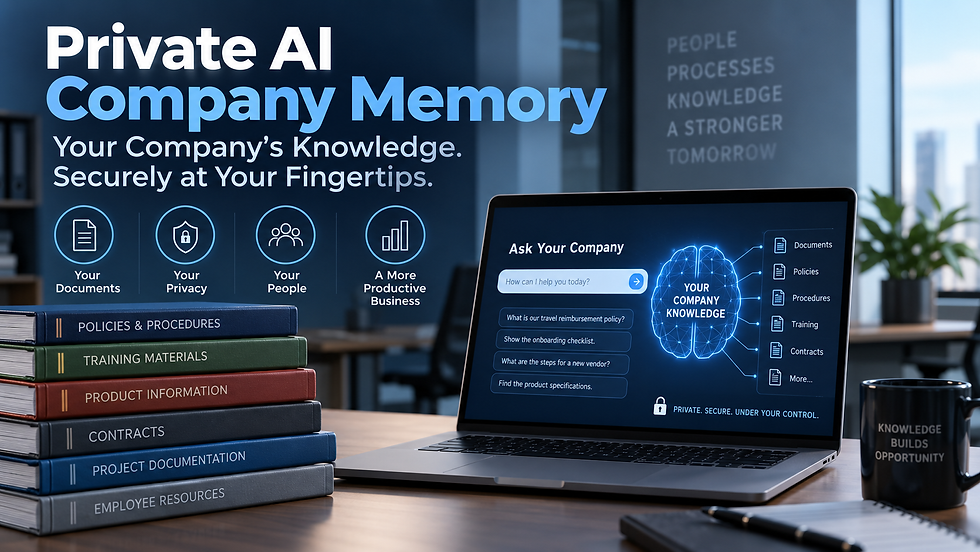
The problem is that much of it is scattered across documents, employee computers, operating procedures, training materials, policies, contracts, emails, manuals, spreadsheets, and years of accumulated experience.
When someone needs an answer, they may have to search through folders, ask another employee, locate an old document, or depend on the one person who remembers how something was done.
That creates an important business problem:
Your company may own the information, but that does not necessarily mean your company can easily use it.
Private AI Company Memory is designed to change that.
Instead of allowing valuable organizational knowledge to remain scattered across files and employees, a Private AI Company Memory system can help transform approved company information into a private, searchable knowledge resource that employees can use to find answers faster.
What Is Private AI Company Memory?
Private AI Company Memory is an artificial intelligence system built around the information your organization already owns.
Depending on the business, that information may include:
Standard operating procedures
Employee manuals
Training materials
Policies and procedures
Product information
Technical documentation
Internal reference guides
Frequently asked questions
Contracts and approved business documents
Historical project information
Customer-service procedures
Sales documentation
Administrative processes
Instead of searching through multiple folders or trying to remember where information is stored, authorized users can ask questions using ordinary language.
For example:
“What is our procedure for handling a new customer complaint?"
“Where is the policy covering employee travel reimbursement?”
“What steps do we follow before approving a new vendor?”
“What documentation is required before this type of project begins?”
The system searches the approved company knowledge and helps the user locate the relevant information.
The goal is not to replace employees.
The goal is to help employees use the organization's existing knowledge more effectively.
Your Business Already Has a Memory
Most established businesses already have what could be called a company memory.
It exists inside:
Documents
Shared folders
Policies
Procedures
Employee experience
Training material
Project records
Manuals
Internal systems
The problem is accessibility.
Important knowledge can become difficult to locate, especially as a business grows.
An employee may spend 20 minutes searching for information another employee already knows.
A new employee may need weeks or months to learn processes that are documented somewhere inside the organization.
A longtime employee may leave the company and take years of practical knowledge with them.
Private AI Company Memory provides another way to organize and access that institutional knowledge.
Why Privacy Matters
Many businesses are interested in artificial intelligence but remain concerned about what happens to their information when AI systems are introduced.
Those concerns are reasonable.
Company information may include proprietary processes, internal policies, financial information, customer information, operational procedures, contracts, or other sensitive materials.
A Private AI Company Memory system can be designed around a different philosophy:
The company's knowledge should remain under the company's control.
Depending on the implementation, the AI system can operate on dedicated private hardware instead of relying on a public AI platform for routine document queries.
That can provide several advantages.
The organization can have greater control over:
Which documents are included
Where the information is stored
Who is allowed to access the system
Which information employees can search
How the AI environment is configured
When the system is updated
For organizations that choose a local deployment, routine use may also avoid the ongoing per-query or token-based AI usage charges associated with many cloud AI services.
That makes Private AI Company Memory particularly interesting for companies that want AI capabilities while maintaining stronger control over their internal information and operating costs.
More Than a Chatbot
A Private AI Company Memory system should not simply be another chatbot connected to a folder.
The real value comes from building the system around the organization.
That means understanding what information employees actually need, which documents should be included, how the information should be organized, and what questions the system must be able to answer reliably.
The implementation should begin with the business problem—not with the technology.
For example, a company may discover that employees repeatedly struggle to find:
HR procedures
Customer-service policies
Technical instructions
Product specifications
Compliance documentation
Project requirements
Training information
Those are specific business problems.
AI becomes useful when it helps solve them.
Formal Testing Before Implementation
One of the most important parts of deploying business AI is testing.
An AI system should not simply be installed and immediately treated as authoritative.
Before implementation, representative questions can be developed based on the company's actual documents and workflows.
The system can then be tested to determine whether it:
Finds the correct information
Uses the appropriate source material
Responds consistently
Identifies situations where information is unavailable
Avoids presenting unsupported answers as established company policy
This testing process helps determine whether the system is ready for practical business use.
It also identifies gaps in the company's documentation.
In some cases, implementing AI reveals something equally valuable: the business itself may have inconsistent, outdated, duplicated, or incomplete information.
Improving the AI system can therefore improve the company's knowledge structure at the same time.
Controlled Implementation
Businesses do not have to make their entire organization AI-enabled overnight.
In many situations, starting small is the better approach.
A Private AI Company Memory project might initially focus on one department, one document collection, or one specific business problem.
For example:
Phase One: Internal policies and procedures
Phase Two: Training and on-boarding documentation
Phase Three: Product or technical knowledge
Phase Four: Additional approved departments and information
This controlled approach allows the organization to evaluate the system, collect employee feedback, measure usefulness, and expand only when the business is comfortable doing so.
AI implementation should be deliberate.
The objective is not to introduce the largest possible system.
The objective is to introduce the right system for the business.
Reducing Dependency on Individual Employees
Every organization has experienced some version of this problem:
“Ask John. He's the only person who knows how that works.”
That represents business risk.
Knowledge concentrated in a single employee can disappear through retirement, resignation, reassignment, illness, or normal employee turnover.
Private AI Company Memory can help preserve documented organizational knowledge so that important information remains accessible to the company.
It does not replace experienced employees.
Instead, it provides a way to preserve and extend the value of what the organization has already learned.
Faster Employee On-boarding
New employees often receive large quantities of information during their first weeks of employment.
Employee manuals.
Procedures.
Training documents.
Policies.
Product information.
Internal processes.
Even when everything is properly documented, finding the correct information can be difficult.
A company memory system can provide another layer of assistance.
Instead of asking coworkers every routine question, a new employee may be able to ask:
“What is the procedure for opening a new customer account?”
or
“Where can I find the company's reimbursement requirements?”
requirements?”
The employee gets help locating the appropriate company information while experienced employees remain available for situations requiring judgment, experience, or human decision-making.
Potential Business Benefits
A properly designed Private AI Company Memory system may help an organization:
Reduce time spent searching for information
Improve access to internal knowledge
Preserve institutional knowledge
Support employee on-boarding
Improve consistency in routine procedures
Reduce dependence on individual employees
Make existing documents more useful
Identify gaps in company documentation
Provide employees with faster access to approved information
For businesses with hundreds or thousands of documents, even modest improvements in information retrieval can become meaningful over time.
Who Should Consider Private AI Company Memory?
The service may be useful for businesses that have accumulated significant internal documentation or rely heavily on repeatable procedures.
Potential candidates include:
Professional services firms, contractors, manufacturers, property-management companies, healthcare-related businesses, logistics companies, financial organizations, legal offices, nonprofit organizations, government contractors, and other organizations that depend on internal knowledge.
Company size alone is not the deciding factor.
A 20-person company with years of documentation may benefit more than a much larger organization with relatively simple information requirements.
The better question is:
Does your organization have valuable information that employees regularly need but sometimes struggle to find?
If the answer is yes, Private AI Company Memory may be worth evaluating.
Start With the Business Problem
Businesses should not purchase AI simply because artificial intelligence is popular.
The first step should be identifying a real operational problem.
Where are employees losing time?
What information is difficult to locate?
Which questions are repeatedly asked?
Where does important knowledge reside?
What would happen if a key employee left tomorrow?
Which documents are used repeatedly?
Those questions help determine whether Private AI Company Memory can create measurable value.
Your Company's Knowledge Is an Asset
Businesses spend years developing procedures, solving problems, training employees, creating documentation, building customer relationships, and learning what works.
That knowledge has value.
Yet much of it remains locked inside documents that employees rarely search effectively.
Private AI Company Memory offers a way to make that information more accessible while keeping the focus on privacy, control, testing, and practical implementation.
Artificial intelligence does not have to begin with replacing employees or moving an entire business into the cloud.
Sometimes the best place to begin is much simpler:
Help your company remember what it already knows.
Is Private AI Company Memory Right for Your Business?
Before implementing anything, the first step is determining whether the technology solves a meaningful business problem.
A short AI Business Fit Review can help identify where information is being lost, where employees spend unnecessary time searching for answers, and whether a private AI knowledge system is appropriate for your organization.
The objective is not to sell AI for the sake of AI.
It is to determine whether artificial intelligence can solve a specific business problem while protecting the knowledge your company has worked years to create.


Comments